FOLIO I · DENKER

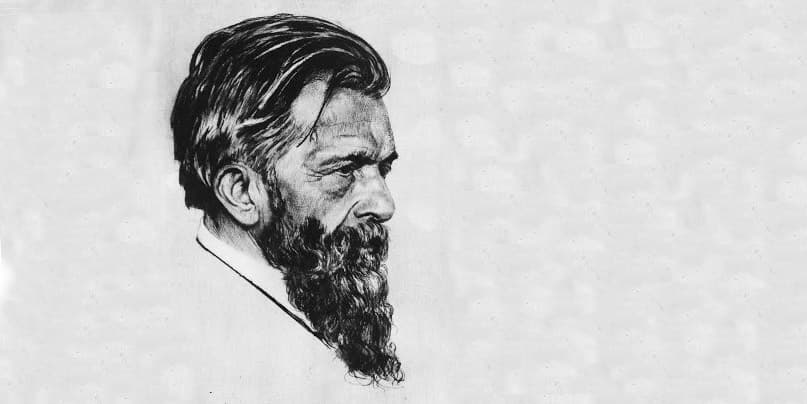
Carl Menger in audio: the life, the one idea, the most famous argument, and which work to read first. About 17 minutes.
New episodes appear continually. The newsletter will let you know when the next one is out.
Born on 23 February 1840 in Neu Sandez (Galicia, today Nowy Sącz, Poland), the third of ten children.[1]
At the age of eight, Menger lost his father; four of his siblings had already died before then. For the family, the result was deprivation and hardship.
Began his studies in law and political science at the University of Vienna.[1]
Continued his studies at the University of Prague from 1860 to 1863.[1]
During his studies, Menger earned his living as a journalist in Lemberg.
Menger was a co-founder of the Wiener Tagblatt and later worked as an editor at the Wiener Zeitung.
Worked as an editor at the Lemberger Zeitung after completing his doctorate.[1]
Publication of the “Principles”, the founding work of the Austrian School. The habilitation followed immediately afterwards.[1]
Editorial secretary of the Wiener Zeitung; observer and market analyst of the Vienna Stock Exchange.[9]
Habilitation in political economy at the University of Vienna in June 1872.[1]
Just a year after his Habilitation, Menger received an associate professorship at the University of Vienna.[1]
Appointed in 1876 as one of the tutors to Crown Prince Rudolf; in 1877 and 1878 Menger accompanied him on study tours through Europe.[1]
Publication of the “Investigations”; the trigger for the Methodenstreit with Gustav Schmoller and the German Historical School.[7]
Appointment as a life member of the Austrian Herrenhaus (House of Lords).[1]
Early retirement (emeritus status) from the University of Vienna for health reasons.[7]
Died on 26 February 1921 in Vienna, in the 9th district, surrounded by a library of some 25,000 volumes.[1]
With the “Investigations into the Method of the Social Sciences” (1883), Menger set off the Methodenstreit with Schmoller and the German Historical School; Schmoller's dismissive review first mocked Menger's followers as the “Austrian School”.[1]
From 1876, for two years, Menger taught Crown Prince Rudolf von Habsburg political economy and statistics and accompanied him on his travels.[1]
Studied law from 1884 to 1887 at the University of Innsbruck, among others under Carl Menger.
After his law studies, he completed his Habilitation under Carl Menger.
In 1887 Carl Menger supervised the doctorate of Ernst Seidler von Feuchtenegg to the degree of Dr. jur. at the University of Vienna.[2]
He studied law at the universities of Czernowitz and Vienna and is explicitly described in the biography as a pupil of Menger.[3]
From 1890 studied history, law and economics at the University of Vienna and attended Carl Menger's lectures on economics; adopted his insistence on the exact definition of concepts and causal investigation.[12]
"Favourite student" and last Habilitation candidate of Carl Menger; studied economics and law at the University of Vienna.
Only reading Menger's “Grundsätze” offered Wieser the perspective he had been seeking, which in retrospect he experienced as a liberation from the “distress of thinking”.[4]
Earned his doctorate in 1904 at the Faculty of Law and Political Sciences of the University of Vienna under Carl Menger and Eugen von Philippovich.[6]
Ludassy was one of the most outstanding pupils in Carl Menger's seminar for graduates who were already in professional life and interested in economics.
Wikipedia DE bestätigt: Landesberger gehörte zur Österreichischen Schule und war Schüler Carl Mengers an der Universität Wien.[11]
Sax was at first a rival, later an ally of Menger in the Methodenstreit, but distanced himself again from the Austrian School a few years after 1887.
Groß wurde von Menger bei der Aufzählung seiner Habilitanten anlässlich seiner Emeritierung nicht erwähnt — ein zwiespältiges Verhältnis trotz formaler Verbindung über die Wiener Habilitation.[5]
Carl Menger in the context of the School as a whole: five generations, their teacher-student lineages, circles and collegial ties.
Show in the family tree →