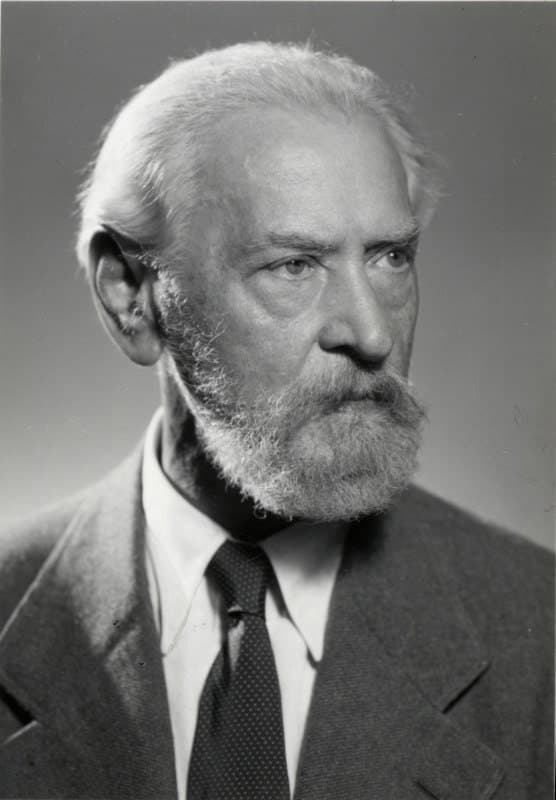
FOLIO I · DENKER

Doctorate in law in 1907.
Worked in the Austrian financial administration until 1911, interrupted by a one-year period of study in Heidelberg.
Appointed associate professor at the University of Freiburg on the strength of unpublished manuscripts (on the theory of price formation), even before completing the Habilitation. Mayer never obtained one.
In 1914 to the German Technical University in Prague.
After the end of the war, Mayer served as head of the Budget Section at the State Office for Military Affairs in Vienna.
Took up a professorship in Graz in 1921.
Appointed to Vienna in 1923 as the successor to Friedrich von Wieser.[4]
Appointed Dean in 1927/1928.
Publication of the roughly 100-page monograph "Der Erkenntniswert der funktionellen Preistheorien" (The Epistemic Value of Functional Price Theories); a critique of equilibrium-analytical approaches.[4]
Received his doctorate in law at the University of Vienna in 1907; identified in the bio_de and in the Klausinger study as a student of Friedrich von Wieser. Wieser developed a father-son relationship with Mayer and supported him by every means.[4]
Mayer was continually embroiled in trench warfare with his opponent Othmar Spann.[4]
Already during his studies, became an assistant to Hans Mayer at the Chair of Political Economy of the University of Vienna and received his doctorate under him in 1925.[1]
Received his doctorate in law in Vienna and became an assistant to Hans Mayer; for racial and faculty-political reasons he was not granted the Habilitation.
Mahr was a student of Hans Mayer, from 1930 his research assistant at the University of Vienna, and in 1950 took over his chair as his successor.
Eventually completed his Habilitation at the University of Vienna under Hans Mayer.[2]
In 1923 Mayer was appointed to the Vienna chair as successor to Friedrich von Wieser; after Wieser's death Mayer moved into the house Wieser had left behind in Vienna's 19th district.[4]
Hans Mayer in the context of the School as a whole: five generations, their teacher-student lineages, circles and collegial ties.
Show in the family tree →