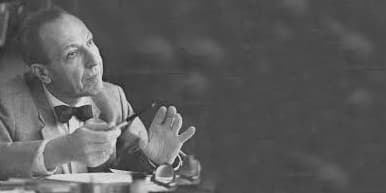
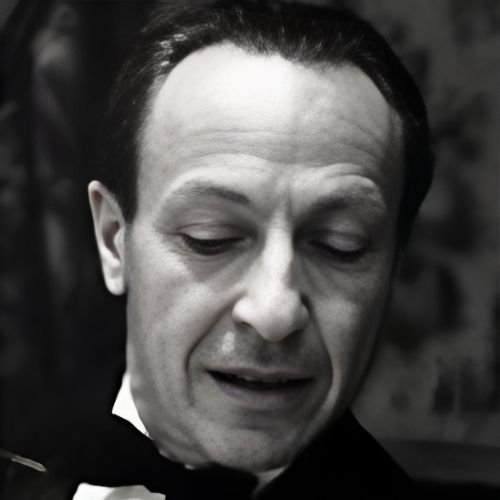
FOLIO I · DENKER

Born on 15 December 1902 in Wiener Neustadt, the son of a Jewish industrialist; he grew up there at his parents' cardboard factory.
Studied political science in Vienna alongside his work in the family cardboard factory.
Received a doctorate (Dr. rer. pol.) at the University of Vienna in 1923 under Ludwig von Mises (dissertation "Die Goldkernwährung" [The Gold Bullion Standard], published 1925).[5]
Publication of the doctoral dissertation "Die Goldkernwährung" (The Gold Bullion Standard) in 1925 (the doctorate, Dr. rer. pol., had already been obtained in 1923 under Mises).
Took part regularly in the Mises private seminar, published reviews, essays, books, and more than 150 newspaper articles, and served as a board member of the Austrian Cardboard Cartel and of the Economic Society.
Taught from 1929 to 1933 at the Volkshochschule Ottakring (an adult education centre).
Publication of "Börsenkredit, Industriekredit und Kapitalbildung" (Stock-Exchange Credit, Industrial Credit and Capital Formation; 1931), an analysis of stock-exchange financing in the light of Austrian monetary theory. Intended as a Habilitation thesis, but the professors Spann and Degenfeld-Schonburg informed him that his application for Habilitation would not be put to a vote on account of his Jewish descent; Hans Mayer, too, was unwilling to support a student of Mises.
Left the country in 1933 following the failed Habilitation on account of his Jewish descent.
Research fellow of the Rockefeller Foundation in the USA from 1933 to 1935.[5]
Became a visiting professor at Harvard University in 1934.
In 1935 he sold his shares in the factory in the Lower Austrian Ybbs Valley and emigrated for good to the USA. During the war he helped numerous people in distress in Austria to leave the country and flee.
Taught from 1935 to 1947 as Frank H. Goodyear Professor at the University at Buffalo.[5]
Taught from 1947 to 1960 as Abram G. Hutzler Professor at Johns Hopkins University in Baltimore.[5]
Taught at Princeton University from 1960 to 1971 as Walker Professor of Economics and International Finance.[5]
Elected to the American Academy of Arts and Sciences in 1961.[7]
Publication of his principal work, "The Production and Distribution of Knowledge in the United States" (1962), which coined the concept of the information society.[5]
Elected President of the American Economic Association in 1966.
President of the International Economic Association from 1971 to 1974.[9]
Taught as a professor at New York University from 1971 until his death in 1983.[5]
Received the Grand Silver Decoration of Honour with Star for Services to the Republic of Austria in 1978.[10]
Died on 30 January 1983 in Princeton, New Jersey, at the age of 80.
From 1920 studied economics at the University of Vienna, among others under Friedrich von Wieser.[5]
Machlup was a regular participant in Mises' private seminar and an intellectual student from the Viennese circle.[1]
The professors Spann and Degenfeld-Schonburg informed Machlup that his application for Habilitation would not be put to a vote because of his Jewish descent.
The professors Spann and Degenfeld-Schonburg informed Machlup that his application for Habilitation would not be put to a vote because of his Jewish descent.
mises.org-Strigl-Biographie nennt Machlup explizit unter den Strigl geprägten Schülern der vierten Wiener Generation.[2]
Beide Teilnehmer am Mises-Privatseminar; mises.org-Liste führt Machlup und Morgenstern als regelmäßige Teilnehmer.[3]
In a letter of 1932 Kauder described Machlup as a “diverse representative” of the Austrian School.[4]
Hayek und Machlup gehörten beide zur Gründungsversammlung der Mont Pèlerin Society 1947; Wikipedia EN führt Machlup in der Kategorie „Members of the Mont Pelerin Society".
He regularly took part in the Mises-Privatseminar, alongside his business activity in his parents' cardboard factory.[1]
Both participants in the Mises-Privatseminar in Vienna.[3]
Fritz Machlup in the context of the School as a whole: five generations, their teacher-student lineages, circles and collegial ties.
Show in the family tree →