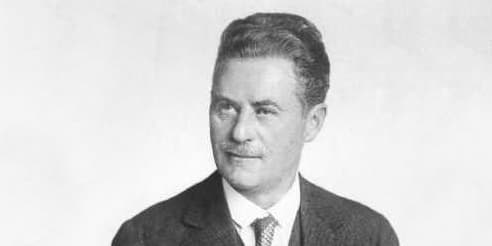
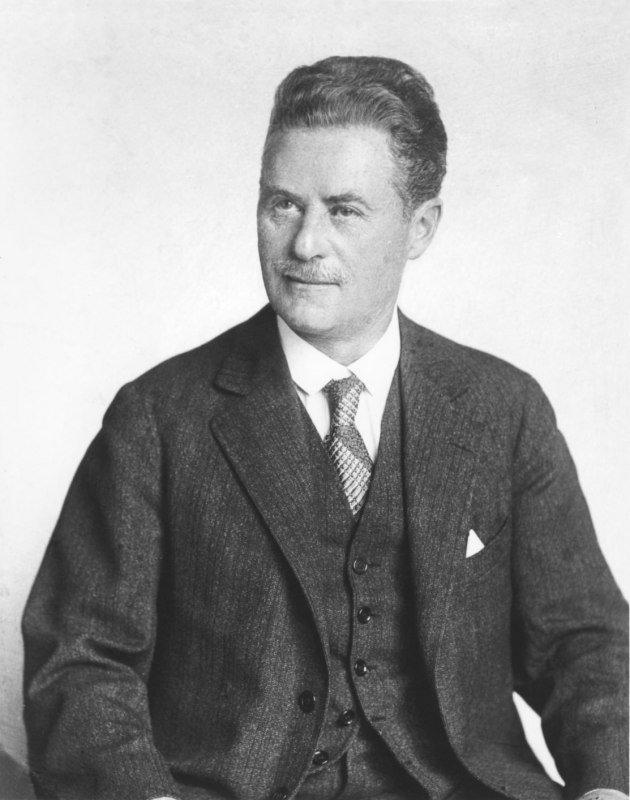
FOLIO I · DENKER

Born on 27 May 1870 in Brünn (today Brno), Moravia, into a Jewish family.
Carl Menger's "favourite student" and last habilitation candidate; owing to the insolvency of his parents' business, he had to finance much of his studies himself.
Studied economics and law at the University of Vienna and received his doctorate in 1892. He was regarded as Carl Menger's "favourite student".[1]
His first work, in which Schüller once again displayed the combative spirit of the Methodenstreit.
Became secretary of the Lower Austrian Trade Association in 1897.[1]
Habilitated in 1899 under Carl Menger in economics at the University of Vienna. Because of his Jewish faith, he subsequently had to content himself with an associate professorship (Extraordinariat).[1]
He was able to habilitate with "Schutzzoll und Freihandel" (Protective Tariffs and Free Trade; 1905), becoming the first member of the Austrian School to enter the field of trade policy.
Publication of "Schutzzoll und Freihandel" (Protective Tariffs and Free Trade); the work is regarded as Schüller's foray into trade policy and as the first contribution by the Austrian School to this field.
As an associate professor, in 1911 he published two notable contributions on labour demand and the labour market.
Schüller rose through the ranks at the Ministry of Trade and was promoted to head of section by Emperor Karl I shortly before the latter's abdication. He remained in this position until his retirement and played a substantial part in the foreign-trade policy of the First Republic.
In 1923, after Menger's death, he supported the publication of the second edition of the "Grundsätze" (Principles of Economics) with a very personal foreword.
Member of the Economic Committee of the League of Nations from 1927; later Austrian envoy to the League of Nations in Geneva.[1]
Taught at the University of Vienna until 1928.
Appointed honorary professor at the University of Vienna in 1930.[1]
Co-editor of the Zeitschrift für Nationalökonomie from 1930 to 1937; he nevertheless drifted increasingly away from the Austrian School.
After the Anschluss in 1938, Schüller was dismissed by the National Socialists and barred from leaving the country. The almost seventy-year-old fled over the Ferwall Pass to Italy in July 1938.[2]
After the racial laws were enacted in Italy, he fled onward to Great Britain.[2]
Was forced to emigrate to the USA in 1940 and continued his teaching there as a professor at the New School for Social Research in New York City until 1952.
Died on 14 May 1972 in Washington, D.C.
"Favourite student" and last Habilitation candidate of Carl Menger; studied economics and law at the University of Vienna.
Co-Autor mit Gusztav Gratz zu wirtschaftspolitischen Themen — Hinweis auf engere Zusammenarbeit im handelspolitischen Umfeld.[3]
Richard Schüller in the context of the School as a whole: five generations, their teacher-student lineages, circles and collegial ties.
Show in the family tree →