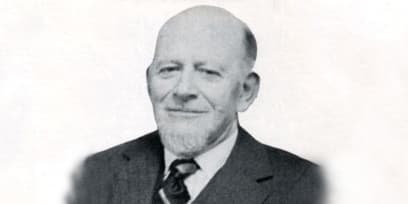
FOLIO I · DENKER
Born on 1 February 1906 in Berlin.
Attended the Askanisches Gymnasium in Berlin; began his studies in 1923.[5]
Studied law and economics at the University of Berlin (Friedrich Wilhelm University, later Humboldt University) from 1924.[6]
Spent the summer of 1926 at the University of Zurich. There his interest in the Austrian School was sparked, particularly in the work of Carl Menger.
Earned his doctorate in economics at the Humboldt University of Berlin.
In 1933 Lachmann emigrated to England. At the London School of Economics he was a student and later a colleague of Friedrich August von Hayek.
Internment as an “enemy alien” from July to December 1940 in England.[4]
From 1941 he was a Lecturer in Economics at the University of London.[6]
Headed the Department of Economics at the University of Hull (Yorkshire, England) from 1943 to 1948.[2]
In 1948 Lachmann accepted an appointment at the University of the Witwatersrand in Johannesburg, South Africa. He worked there until his retirement in 1972.
His principal work Capital and Its Structure (1956) — a contribution to Austrian capital theory.[1]
President of the Economic Society of South Africa, 1962/63.[2]
Keynote speaker at the South Royalton Conference in 1974 in Vermont — the spark for the modern revival of the Austrian School in the United States.[3]
Worked with Israel M. Kirzner at New York University from 1974 to 1987; Kirzner sought to revive the tradition of the Austrian School.
As a visiting professor, Lachmann organized a seminar on the Austrian School in each winter semester from 1975 to 1987.
Received an honorary doctorate from the University of the Witwatersrand in 1986.[2]
Died on 17 December 1990 in Johannesburg.
Doctorate in 1930 at the University of Berlin under Werner Sombart, who also introduced him to the work of Max Weber.[5]
At the LSE, Lachmann belonged to Hayek's closest academic circle and developed radical subjectivism further out of this line.
Lachmann nahm laut Pipeline-Briefing als jüngeres Mitglied am Mises-Privatseminar teil; vor seiner Emigration nach London 1933.
After his studies, a colleague of Friedrich August von Hayek at the London School of Economics; collaboration until the move to Johannesburg in 1948.
Arbeitete von 1974 bis 1987 an der New York University mit Israel M. Kirzner zusammen, der die Tradition der Österreichischen Schule wiederbeleben wollte.
Became a close friend of Ludwig Lachmann at the LSE; Lachmann developed his theory of divergent expectations further out of Shackle's work on uncertainty.[6]
Ludwig Lachmann in the context of the School as a whole: five generations, their teacher-student lineages, circles and collegial ties.
Show in the family tree →