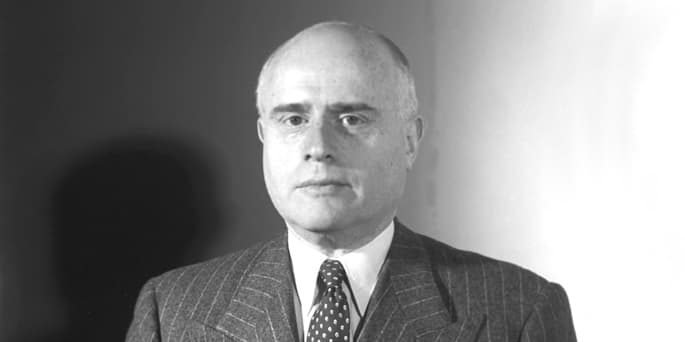
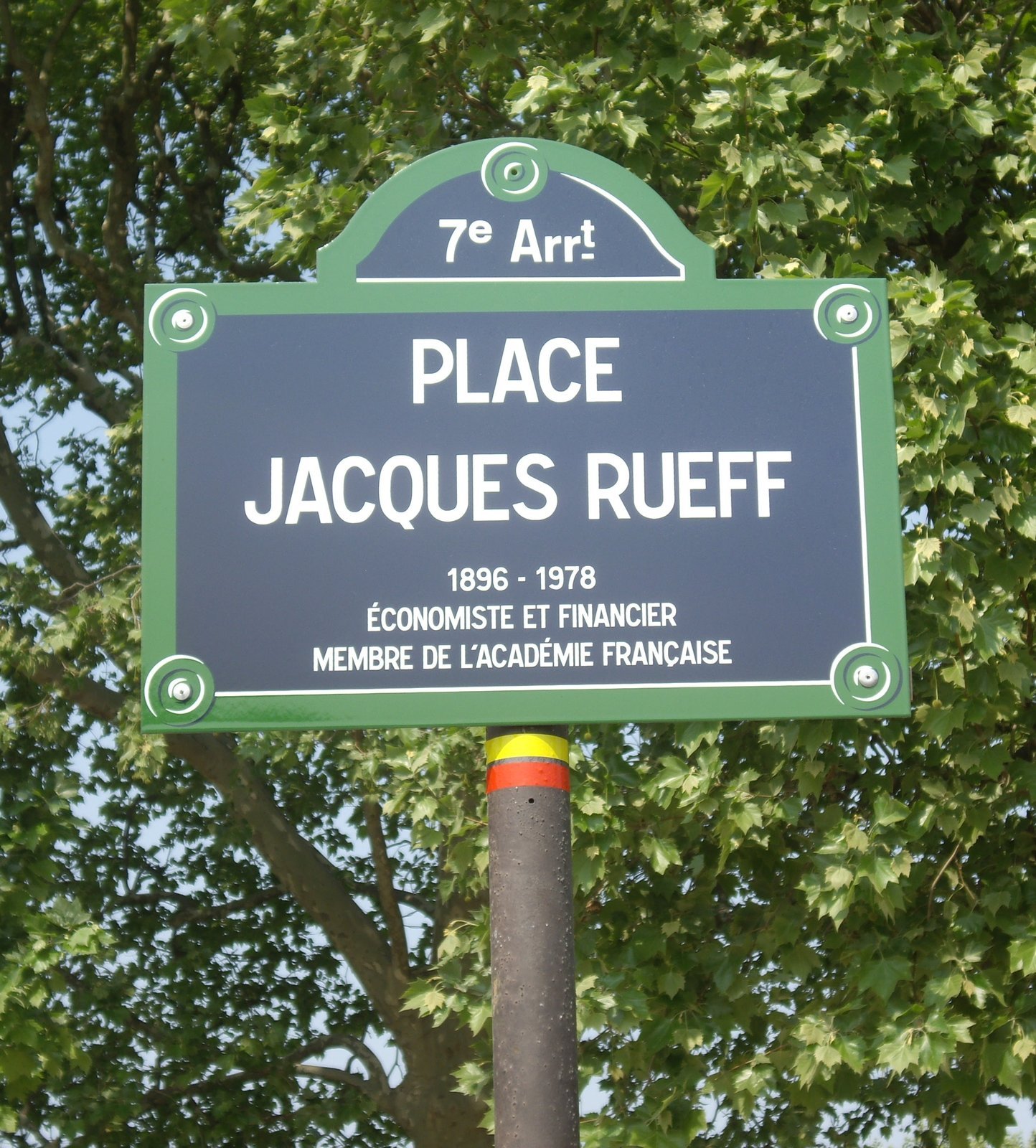
FOLIO I · DENKER

Born on 23 August 1896 in Paris.
Artillery officer in the First World War; from 1917, liaison officer to the First American Army Division (an associate of Colonel Alexander Patch).[1]
After the First World War, he demonstrated in the hyperinflation countries France, Italy, Germany, Poland and Austria that the money supplies issued by the central banks had been used primarily to finance budget deficits.
Studied at the École Polytechnique (class X1919S, for war veterans) and at the École libre des sciences politiques.[1]
Joined the Corps des Inspecteurs des Finances; in the 1920s, an associate of Raymond Poincaré.[1]
Publication of the monetary-theory work <em>Théorie des phénomènes monétaires</em> (Theory of Monetary Phenomena) and research on hyperinflation in France, Italy, Germany, Poland, and Austria.
From 1936 to 1939, Directeur du Mouvement général des Fonds (today the Direction du Trésor) at the French Ministry of Finance, under the Popular Front government.[1]
Appointed second Sous-Gouverneur (Deputy Governor) of the Banque de France on 8 September 1939; resigned on 22 January 1941.[1]
Member of the Mont Pèlerin Society, initiated by Friedrich August von Hayek.
Minister of State (Ministre d'État) of the Principality of Monaco from 12 July 1949 to 1 August 1950, under Prince Rainier III.[1]
Judge at the European Court of Justice (ECSC, later EEC) from 1952 to 1962.[1]
Under President Charles de Gaulle after the Second World War, he initiated the stabilisation of the French currency.
Elected to the Académie française in 1964, to seat no. 31 (succeeding Jean Cocteau); later Chancellor of the Institut de France.[2]
Publication of "Die Währungssünden der westlichen Welt" (The Monetary Sins of the Western World; French 1971); a plea for the return to the gold standard and an engagement with Keynes.
Died on 23 April 1978 in Paris.
At the École Polytechnique a student of Clément Colson, who had a deep influence on Rueff's economic thought (mathematical economics, classical tradition).[1]
Walras' Schriften inspirierten Rueff 1921 in seinem letzten Polytechnique-Jahr zur ökonomischen Forschung — Werk-Einfluss ohne persönliche Begegnung (Walras starb 1910).[1]
Adviser to Charles de Gaulle from 1958; architect of the Pinay-Rueff plan for stabilising the franc (17% devaluation, restoration of convertibility, balanced budget).[3]
Always a resolute opponent of the ideas of John Maynard Keynes; a strong advocate of a return to the gold standard.
Belonged to the Mont Pèlerin Society initiated by Hayek; joined in 1948.
Joint Pinay-Rueff plan of 1958–1960 for the consolidation of French public finances and the stabilisation of the franc.[3]
Jacques Rueff in the context of the School as a whole: five generations, their teacher-student lineages, circles and collegial ties.
Show in the family tree →