FOLIO I · THINKER · GEN. 04 · N° 074

Eric Voegelin

Works
7
Articles
0
Generation
4.
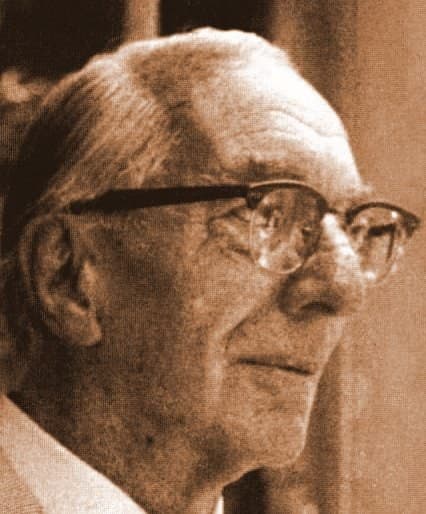
Portrait of Eric Voegelin
FOL. 04 · N° 074 · Eric Voegelin
BIOGRAPHY

Life and Work

Eric Voegelin, born Erich Hermann Wilhelm Vögelin on 3 January 1901 in Cologne, came to Vienna with his parents in 1910, where he attended the secondary school (Realgymnasium). From 1919 he studied at the Faculty of Law and Political Science of the University of Vienna. In 1922 he received his doctorate under Hans Kelsen and Othmar Spann with the dissertation "Wechselwirkung und Gezweiung. Eine methodenkritische Untersuchung" (Interaction and Dyadic Pairing: A Critical Inquiry into Method). Years of study in the United States followed (from 1924 to 1926 at Columbia University, Harvard, the University of Wisconsin, and Yale), as well as a year in Paris. In 1928 he qualified as a university lecturer in Vienna with the work "Über die Form des amerikanischen Geistes", published in English as "On the Form of the American Mind". From 1929 he taught as a Privatdozent (unsalaried lecturer) in the theory of the state and sociology; in 1936 he became an assistant professor and research assistant to Hans Kelsen. In his Vienna years Voegelin moved in four very differently oriented discussion circles: Othmar Spann's seminar, Hans Kelsen's private seminar, Ludwig von Mises's private seminar, and the Geistkreis, founded in 1921 by Friedrich August von Hayek and Josef Herbert Fürth. From this period also dates his lifelong friendship with Alfred Schütz, continued after 1938 in an extensive correspondence. After the Anschluss of 1938, Voegelin was dismissed from the university, narrowly escaped arrest by the Gestapo, and fled via Switzerland to the United States. After short teaching posts at Harvard, Bennington, and in Alabama, in 1942 he came to Louisiana State University in Baton Rouge, where he taught until 1958. In 1944 he was granted US citizenship. In 1958 he accepted a call to the Ludwig Maximilian University of Munich, to the chair once held by Max Weber and vacant since 1920, and founded the Institute of Political Science. In 1969 he returned to the United States, first as Henry Salvatori Distinguished Scholar, later as senior research fellow of the Hoover Institution at Stanford. He died on 19 January 1985 in Palo Alto. Voegelin's work ranges from early critiques of race theory in "Rasse und Staat" (Race and State, 1933), through the analysis of modern totalitarian movements as secular substitute religions in "Die politischen Religionen" (The Political Religions, 1938), to the large-scale political philosophy of his late phase, above all "The New Science of Politics" (1952) and the five-volume series "Order and History" (1956 to 1987, the final volume posthumous). With his thesis on Gnosticism he became one of the most influential political thinkers of the twentieth century.
Metadata
3. Januar 1901
19. Januar 1985
Generation 4
Life stations

Stations

  1. 1910
    1910
    Umzug der Familie von Köln nach Wien

    Der neunjährige Voegelin zieht mit seinen Eltern nach Wien und besucht dort das Realgymnasium.

  2. ⁦1919–1922⁩
    ⁦1919–1922⁩
    Studies at the University of Vienna

    Studium der Staats- und Gesellschaftslehre an der rechts- und staatswissenschaftlichen Fakultät.

  3. 1922
    1922
    Doctorate (Dr. rer. pol.)

    Dissertation „Wechselwirkung und Gezweiung. Eine methodenkritische Untersuchung" bei Hans Kelsen und Othmar Spann.

  4. ⁦1924–1926⁩
    ⁦1924–1926⁩
    Studienjahre in den Vereinigten Staaten

    Studienaufenthalte an Columbia, Harvard, University of Wisconsin und Yale; Begegnungen mit John Dewey, Alfred N. Whitehead und John R. Commons.

  5. 1928
    1928
    Habilitation at the University of Vienna

    Habilitationsschrift „Über die Form des amerikanischen Geistes".

  6. ⁦1929–1938⁩
    ⁦1929–1938⁩
    Privatdozent, ab 1936 Assistenzprofessor

    Lehre für Staatslehre und Soziologie; 1936 Assistenzprofessor und wissenschaftlicher Assistent bei Hans Kelsen.

  7. 1938
    1938
    Flucht nach dem Anschluss

    Nach der Entlassung von der Universität entgeht Voegelin knapp der Gestapo, flieht über die Schweiz und gelangt in die USA.

  8. ⁦1939–1942⁩
    ⁦1939–1942⁩
    Erste US-Stationen

    Harvard Fellow (1939), Assistant Professor an Bennington College und der University of Alabama.

  9. ⁦1942–1958⁩
    ⁦1942–1958⁩
    Louisiana State University

    Zunächst Visiting Professor, ab 1946 Full Professor am Department of Government der LSU.

  10. 1944
    1944
    US Citizenship

    Voegelin und seine Frau Lissy erhalten 1944 die amerikanische Staatsbürgerschaft.

  11. ⁦1958–1968⁩
    ⁦1958–1968⁩
    Lehrstuhl Max Webers an der LMU München

    Voegelin übernimmt den seit 1920 vakanten Max-Weber-Lehrstuhl und gründet das Institut für Politische Wissenschaft an der Ludwig-Maximilians-Universität München.

  12. ⁦1969–1985⁩
    ⁦1969–1985⁩
    Hoover Institution, Stanford University

    Rückkehr in die USA als Henry Salvatori Distinguished Scholar (1969 bis 1974), danach Senior Research Fellow an der Hoover Institution bis zum Tod 1985.

  13. 1985
    1985
    Tod in Palo Alto

    Voegelin stirbt am 19. Januar 1985 in Palo Alto, Kalifornien.

Relationships

Influences

Influenced by · 5
  1. ⁦1919–1922⁩
    ⁦1919–1922⁩
    Hans Kelsen⁦(1881–1973)⁩ · Wiener Rechtstheorie

    Together with Othmar Spann, Kelsen supervised Voegelin's dissertation “Wechselwirkung und Gezweiung” (1922).[3]

  2. ⁦1919–1922⁩
    ⁦1919–1922⁩
    Othmar Spann⁦(1878–1950)⁩ · Universalismus

    Alongside Kelsen, Spann was the supervisor of Voegelin's dissertation.[3]

  3. 1928
    1928
    Hans Kelsen⁦(1881–1973)⁩ · Wiener Rechtstheorie

    Voegelin completed his Habilitation in 1928 within Kelsen's circle; from 1936 he was Kelsen's assistant professor and research assistant for constitutional and administrative law.[4]

  4. ⁦1934–1964⁩
    ⁦1934–1964⁩
    Leo Strauss⁦(1899–1973)⁩ · Politische Philosophie

    Correspondence between Voegelin and Strauss from 1934 to 1964 on the relationship between faith and knowledge.[1]

  5. Max Weber⁦(1864–1920)⁩ · Heidelberger Schule

    Voegelin saw himself as a student of Weber in the tradition of value-free science; in 1958 he took over Weber's former chair at the LMU in Munich.[5]

Eric Voegelin in the context of the School as a whole: five generations, their teacher-student lineages, circles and collegial ties.

SOURCES ON STATIONS AND RELATIONSHIPS10 citations · 2 sources
  • [1]Glaube und Wissen: Briefwechsel Voegelin–Strauss 1934–1964 (Fink 2010)
  • [2]Faith and Political Philosophy: Strauss–Voegelin Correspondence 1934–1964 (Penn State 1993)
CATALOGUE OF WORKS · CHRONOLOGICAL

The Books

1920s
1928
Über die Form des amerikanischen Geistes
OriginalGerman
1930s
1933
Rasse und Staat
OriginalGerman
1936
Der autoritäre Staat
OriginalGerman
1938
Die politischen Religionen
OriginalGerman
1950s
1952
The New Science of Politics
OriginalEnglish
1956
Order and History
OriginalEnglish
1960s
1966
Anamnesis. Zur Theorie der Geschichte und Politik
OriginalGerman
APA
Chicago
German historical style