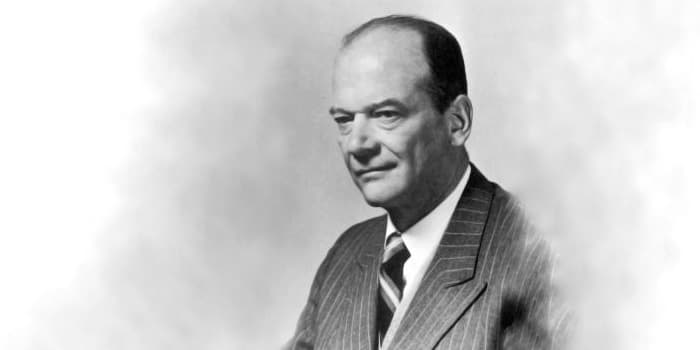
FOLIO I · DENKER

Born on 20 July 1900 in Purkersdorf near Vienna, the scion of a minor-noble family of civil servants (von Haberler).
Doctorate in law at the University of Vienna in 1923.
Doctorate in political science at the University of Vienna in 1925. Subsequently worked at the Chamber of Commerce.
Publication of "Der Sinn der Indexzahlen" (The Meaning of Index Numbers; 1927), Haberler's Habilitation thesis.
Completed postgraduate studies in London and at Harvard University in 1927/28.
After returning from London and Harvard, Habilitation at the University of Vienna with "Der Sinn der Indexzahlen" (The Meaning of Index Numbers; 1927).
Taught courses at the University of Vienna, in part together with Friedrich August von Hayek and Oskar Morgenstern. Regular participation in the Mises private seminar.
Guest lectures at Harvard University in 1931/32.
In 1934 he received an offer to compile a broad survey of all the current business cycle theories for the League of Nations, which brought him into contact with almost every prominent economist in the world.
Professor at Harvard University from 1936 to 1971; worked with Joseph Schumpeter, among others.[1]
His major work "Prosperity and Depression" (1937), the outcome of the League of Nations commission.
Shortly before the publication of <em>Prosperity and Depression</em> (1937), Haberler accepted an appointment at Harvard.
As a politically undesirable figure, Haberler was stripped of his Austrian teaching licence in his absence immediately after the Anschluss.
Elected to the American Academy of Arts and Sciences in 1939.[7]
First President of the International Economic Association from 1950 to 1953.[8]
Elected President of the American Economic Association in 1963. Also an adviser to the Board of Governors of the American central banking system.
Moved from Harvard in 1971 to become a resident scholar at the American Enterprise Institute (AEI) in Washington, D.C., where he remained active until his death in 1995.[1]
Died on 6 May 1995 in Washington, D.C., at the age of 94.
Studierte an der Universität Wien u. a. bei Friedrich von Wieser; Promotion in Staatswissenschaften 1925.[1]
Studied at the University of Vienna under Ludwig von Mises, among others; later a regular participant in the Mises-Privatseminar.[2]
mises.org-Strigl-Biographie nennt Haberler explizit unter den Strigl geprägten Schülern der vierten Wiener Generation.[3]
Fellow participant in the Mises-Privatseminar in Vienna.
Haberler regularly took part in the Mises-Privatseminar in Vienna.[2]
Haberler held his courses at the University of Vienna partly jointly with Friedrich August von Hayek.
Haberler held his courses at the University of Vienna partly jointly with Oskar Morgenstern.[4]
As a professor at Harvard University, Haberler worked together with Joseph Schumpeter.[5]
Both participants in the Mises-Privatseminar in Vienna.[4]
Gottfried Haberler in the context of the School as a whole: five generations, their teacher-student lineages, circles and collegial ties.
Show in the family tree →