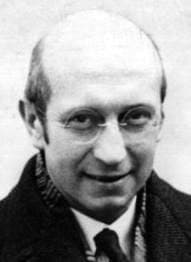
FOLIO I · DENKER

Born on 7 February 1891 in Rokitzan (today Rokycany), Bohemia, into a Bohemian family of civil servants.[1]
Studies in law and political science at the University of Vienna from 1909, after his secondary-school years in Laibach (today Ljubljana). He was admitted to Eugen von Böhm-Bawerk's private seminar as a very young student.[1]
War service as a reserve lieutenant from 1915 to 1918.[1]
Joined the Industrial Commission in 1920, later in a senior position at the State Office for Labour (unemployment insurance); he remained in this role until 1938, after which he was transferred to the Statistical Office.[1]
A long-standing participant in the Mises private seminar; one of the few members of the Austrian School to have completed a habilitation.[1]
Teaching at the University of Vienna and additionally at the Hochschule für Welthandel (College of World Trade).
The expanded habilitation thesis appeared as "Die ökonomischen Kategorien und die Organisation der Wirtschaft" (The Economic Categories and the Organisation of the Economy).
Appointed titular associate professor at the University of Vienna in 1928.[1]
Additional teaching post at the Hochschule für Welthandel (College of World Trade) in Vienna in 1930.[1]
"Kapital und Produktion" (Capital and Production) appears, a further development of the Austrian theory of money and the business cycle dealing with changes in the value of money and misallocations.[3]
The textbook "Einführung in die Grundlagen der Nationalökonomie" (Introduction to the Foundations of Economics), written in a factual, clear and accessible style.
In 1938, after the Anschluss, he was transferred from the Labour Office to the Statistical Office — formally stripped of power, but remaining in the country.[1]
Died on 11 November 1942 in Vienna of a brain tumour; he had remained in the country after the Anschluss.[1]
Wurde als sehr junger Student in Eugen von Böhm-Bawerks Privatseminar an der Universität Wien aufgenommen; mises.org bezeichnet Strigl als „einen der jüngsten Böhm-Bawerk-Schüler".[3]
mises.org-Strigl-Biographie nennt Hayek explizit als von Strigl geprägten Schüler: „Strigl shaped the minds of Hayek, Haberler, Machlup, Morgenstern, and other future great Viennese economists more than any other teacher." Hayek-Nachruf 1942: „with his death disappears the figure on whom one's hope for a preservation of the tradition of Vienna as a centre of economic teaching... had largely rested."[3]
mises.org-Strigl-Biographie nennt Machlup explizit unter den Strigl geprägten Schülern der vierten Wiener Generation.[3]
mises.org-Strigl-Biographie nennt Haberler explizit unter den Strigl geprägten Schülern der vierten Wiener Generation.[3]
Joseph Steindl wird in der mises.org-Strigl-Biographie als Schüler („one of his pupils") geführt; verfasste den Nachruf auf Strigl.[3]
mises.org-Strigl-Biographie nennt Morgenstern explizit unter den Strigl geprägten Schülern der vierten Wiener Generation.[3]
Strigl wurde als sehr junger Student in Böhm-Bawerks Wiener Privatseminar aufgenommen — Mit-Teilnehmer waren u. a. Otto Bauer, Nikolai Bucharin, Ludwig von Mises, Otto Neurath und Joseph Schumpeter.[3]
Long-standing participant in the Mises Privatseminar in Vienna; one of the few habilitated members of the Austrian School in the circle.[1]
In 1928 Strigl published in an edited volume co-edited by Frank Albert Fetter; Fetter acted as editor of the volume.[1]
Both participants in the Mises-Privatseminar in Vienna.[4]
Richard von Strigl in the context of the School as a whole: five generations, their teacher-student lineages, circles and collegial ties.
Show in the family tree →