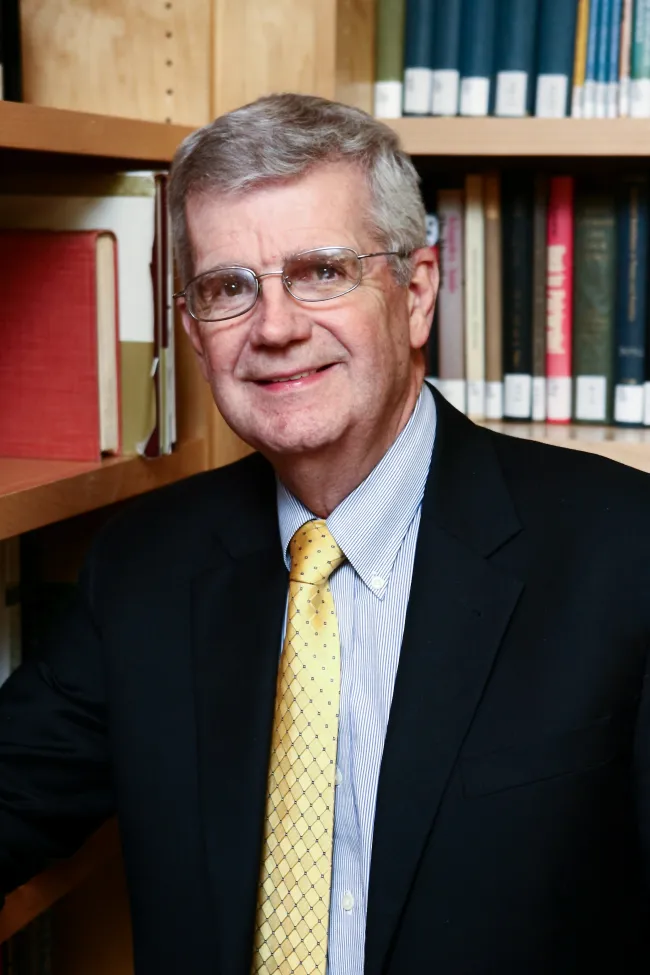
BIOGRAPHY
Life and Work
Roger Wayne Garrison was born in 1944 in Joplin, Missouri, and at first grew up far from economics. His first course of study took him in 1967 to the University of Missouri-Rolla, where he completed a bachelor's degree in electrical engineering. He then served as an officer in the United States Air Force, finally with the rank of Captain, and worked at the Rome Laboratory of Griffiss Air Force Base as a systems engineer for electronic countermeasures. Only after his discharge did he turn to economics; he earned a master's degree in 1974 at the University of Missouri-Kansas City and his doctorate in 1981 at the University of Virginia under Leland B. Yeager. In 1978 he joined Auburn University in Alabama as an instructor, became Assistant Professor in 1981, Associate Professor in 1988, and was appointed full professor in 1996. At Auburn he taught macroeconomics and monetary theory for more than three decades, until his retirement. His main contribution is capital-based macroeconomics: a graphical synthesis of Hayek's triangle of the structure of production, Rothbard's intertemporal market diagram, and a modified consumption-investment frontier. With this set of tools he made Austrian business cycle theory compatible with modern economics textbooks and showed, in a single set of diagrams, how monetary policy distorts the intertemporal capital structure. His main work, "Time and Money: The Macroeconomics of Capital Structure", appeared in 2001 with Routledge and, in the same year, earned him the Vernon Smith Prize for the Advancement of Austrian Economics. In 2003 he was the first Hayek Visiting Fellow at the London School of Economics, and in 2004 President of the Society for the Development of Austrian Economics. He was also, for many years, an Adjunct Scholar at the Mises Institute. Garrison died on 13 February 2026, six days after his eighty-second birthday, in Auburn, Alabama. His legacy is the didactic achievement of having translated a tradition of capital theory, long regarded as verbal and hard to access, into an elegant visual language, and of thereby shaping a whole generation of Austrian macroeconomists.
Metadata
- Born
- 7. Februar 1944
in Joplin, Missouri, USA - Died
- 13. Februar 2026
- Generation
- Generation 5