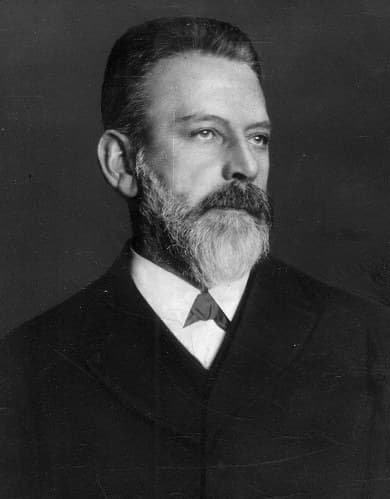
FOLIO I · DENKER

Passed the Matura in 1872 at the Akademisches Gymnasium in Vienna; his classmates included the later President Tomáš Garrigue Masaryk and the minister Franz Klein.[5]
An exemplary civil-service career in the financial administration; he rose to the rank of head of section.
Habilitation thesis "Die Principien der gerechten Besteuerung in der neueren Steuertheorie" (The Principles of Just Taxation in Recent Tax Theory; Berlin 1884), written as a proponent of the subjective theory of value; later the basis for the reform of direct personal taxation together with Eugen von Böhm-Bawerk.
Habilitated in 1884 as a Privatdozent in public finance, economics and statistics at the University of Vienna.[4]
Taught at the Vienna Commercial Academy from 1885 to 1895.[4]
His teaching licence was extended to political economy in 1887; he taught as a public-finance scholar at the University of Vienna and at other Viennese educational institutions.
Publication of "Das Wesen des Einkommens. Eine volkswirthschaftliche Untersuchung" (The Nature of Income: An Economic Inquiry; Berlin 1887).[1]
He taught as a public-finance scholar at the University of Vienna and at other Viennese educational institutions.
Taught at the Oriental (later the Consular) Academy in Vienna from 1890 to 1900.[4]
Appointed head of section at the Imperial-Royal Ministry of Finance in 1899 and headed the department for direct taxes.[4]
Publication of "Das Zeitverhältnis zwischen der Steuer und dem Einkommen" (The Temporal Relationship between Tax and Income; Vienna 1901).[2]
Appointed honorary professor at the University of Vienna in 1901; he taught until his death.[4]
Became President of the Central Statistical Commission in 1910 and, for a short time, also Minister of Finance; he then retired.[5]
A year after retiring he was again appointed President of the Central Statistical Commission and held the office until his death.[5]
From 1911 he served as co-editor of the Zeitschrift für Volkswirtschaft, Socialpolitik und Verwaltung (Journal for Economics, Social Policy and Administration).
In the history-of-economic-thought literature on the Viennese theory of taxation, he is treated, together with Emil Sax, as one of the two outstanding Austrian theorists of taxation; both developed in parallel a public finance grounded in marginal utility.[3]
As a subjectivist value theorist, together with Eugen von Böhm-Bawerk as the senior official in charge, he put progressive taxation into practice in the reform of the direct personal tax.
Robert Meyer in the context of the School as a whole: five generations, their teacher-student lineages, circles and collegial ties.
Show in the family tree →