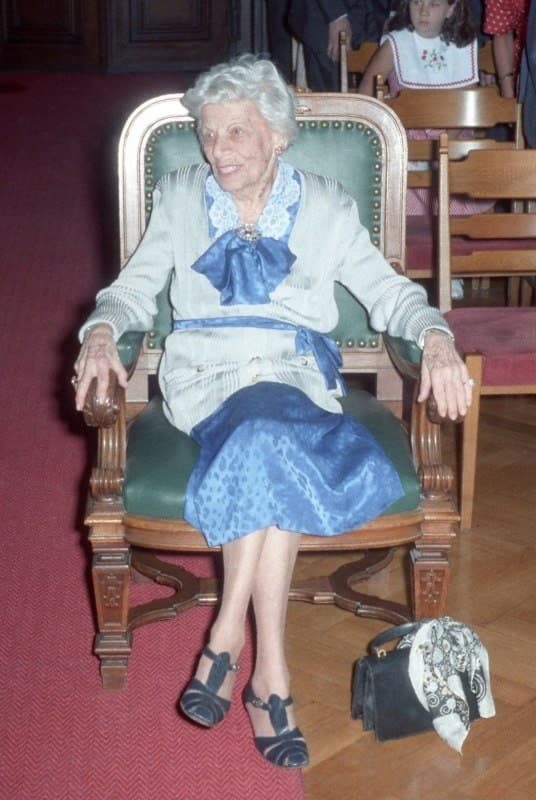
FOLIO I · DENKER

Work at the Kriegs-Getreide-Anstalt (War Grain Agency) from 1918 to 1919; during this time also an auditing student of Max Weber.[4]
Winter semester 1919/20 as an auditing student at the University of Freiburg im Breisgau.[4]
A participant in Ludwig von Mises's private seminar at the Vienna Chamber of Commerce, together with Hayek, Haberler, Morgenstern, and others.[5]
Received a doctorate in political science in 1921, as one of the first women to do so at the University of Vienna.[4]
After her doctorate she worked as a freelance economics journalist; she wrote reviews on a regular basis, contributions on banking and monetary matters, and pieces on questions of economic policy.
Publications on currency policy (1923) as a freelance economics journalist.[1]
Publication of “Theorie der staatlichen Wirtschaftspolitik” (Theory of State Economic Policy) — the first attempt in the German language at a theoretical foundation and delimitation of economic policy.[4]
After the Anschluss, Braun emigrated to the USA.
Professorship at Brooklyn College in New York from 1947 to 1969.
After becoming professor emerita, she taught for twelve years as a visiting professor at New York University.
Honorary doctorate in economics from the University of Vienna in 1989.[6]
Attended Max Weber's lectures during her work at the Kriegs-Getreide-Anstalt in Vienna (1918-1919).[4]
Received her doctorate in 1921 as one of the first women in the political sciences at the University of Vienna; the dissertation "Die Anweisungstheorie des Geldes" (The Assignment Theory of Money) was supervised by Ludwig von Mises.[2]
Stephanie Martha Braun in the context of the School as a whole: five generations, their teacher-student lineages, circles and collegial ties.
Show in the family tree →