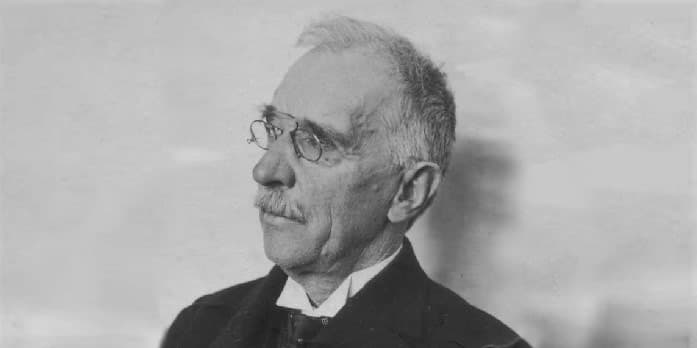
FOLIO I · DENKER

Studies in law and political science at the University of Innsbruck (1879–1883).[1]
Doctorate of law (Dr. jur.) at the University of Innsbruck in 1884. Subsequently legal practice.[1]
Venia legendi in economics at Innsbruck in 1889, following legal practice.[1]
Transfer of the venia legendi to the University of Vienna in 1892.
Extension of the venia legendi to the whole of political economy in 1895.
Position at the Central Statistical Commission in Vienna.
Appointed to the German Technical University in Brünn in 1899.[2]
Chair at the Hochschule für Bodenkultur (College of Agriculture) in Vienna from 1901 to 1915 (also teaching economics in parallel at the Technische Hochschule).[1]
Rector of the Hochschule für Bodenkultur (College of Agriculture) in Vienna from 1903 to 1905.[1]
Awarded the official title of Hofrat (Court Councillor) in 1904 in the course of his work as an officer (Referent) at the Ministry of Agriculture.[2]
Publication of the textbook "Grundzüge der Volkswirtschaftslehre" (Principles of Economics), based on the subjectivist theory of value.
From 1915, chair of economics at the University of Innsbruck.
Commander of the Imperial Austrian Order of Franz Joseph in 1916.[2]
Rector of the University of Innsbruck from 1922 to 1925.[1]
Publication of "Agrarpolitik" (Agricultural Policy; 1924); a turn toward questions of agrarian history and agricultural policy.[1]
Student of Eugen Böhm-Bawerk during the latter's teaching in Innsbruck; on this basis he received the venia legendi in economics in 1889 and turned to the marginal-utility school.[1]
Hermann von Schullern zu Schrattenhofen in the context of the School as a whole: five generations, their teacher-student lineages, circles and collegial ties.
Show in the family tree →