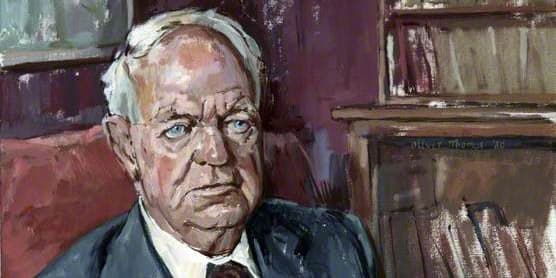
FOLIO I · DENKER

Born on 14 July 1903 in Cambridge. His father was a mathematics teacher and prepared John Maynard Keynes for a scholarship at Eton College.
Attended the Perse School in Cambridge but had to abandon his studies for financial reasons and worked as a bank clerk.[1]
Since his parents could not support him, Shackle worked as a bank clerk and, while training as a teacher, studied on the side for a BA degree at the University of London, which he obtained in 1931.
Began his doctoral thesis under Friedrich Hayek at the LSE, then turned to an interpretation of Keynes's General Theory of Employment, Interest and Money. Doctorate in 1937.
Appointed in 1939, after the outbreak of the Second World War, to the S-Branch, Winston Churchill's inner circle of economists.
After the end of the war, posts at the Cabinet Office and the University of Leeds before his appointment to Liverpool.[1]
Holder of the Brunner Chair of Economics at the University of Liverpool from 1951 until his retirement in 1969.
Died on 3 March 1992 at the age of 88 in Aldeburgh, Suffolk; his scholarly papers are held in the Cambridge University Library.
Shackle begann seine Doktorarbeit unter der Leitung Friedrich Hayeks an der LSE, wechselte dann allerdings zu einer Interpretation von Keynes' General Theory of Employment, Interest and Money und erlangte den Doktorgrad 1937.
Gunnar Myrdal influenced Shackle's thinking especially with regard to the ex-ante / ex-post analysis.[1]
During his doctoral work, Shackle switched to an interpretation of Keynes' General Theory of Employment, Interest and Money.
G.L.S. Shackle in the context of the School as a whole: five generations, their teacher-student lineages, circles and collegial ties.
Show in the family tree →